


More than 50 years after he hung beneath a bridge under enemy fire to stop a North Vietnamese armored invasion, the heroic actions of John Ripley are set to be recognized with the nation’s highest award for valor.
As North Vietnamese tanks massed on the far side of the river in 1972, Ripley climbed onto the Dong Ha Bridge carrying explosives — knowing that if the bridge stood, the invasion could roll south.
During the opening days of the Easter Offensive, Ripley hung from the steel girders of the Dong Ha Bridge in the northern part of South Vietnam, hauling hundreds of pounds of explosives across the structure and rigging them by hand as enemy forces advanced.
When the charges detonated, the bridge collapsed into the river below, halting a massive North Vietnamese armored advance and buying critical time for South Vietnamese and U.S. forces to respond.
Now, more than five decades later, Ripley’s extraordinary act of courage has been formally approved by the Senate, through special legislation, for the Medal of Honor.
In an exclusive interview with Military.com, Ripley’s son, Tom Ripley (also a Marine), described the moment as both deeply emotional and long anticipated.
“It’s kind of surreal for my family,” he said. “I’ve spent my entire life watching this play out. And now suddenly we’re at this moment.”
For generations of Marines, the story of Ripley hanging beneath a bridge while rigging explosives under enemy fire has become legendary, a moment that captures Ripley’s leadership philosophy: Mission first, Marines always.

A War Nearing Its Most Dangerous Moment
By the spring of 1972, the Vietnam War had entered a new phase. The United States had begun withdrawing most of its combat forces, leaving a small advisory presence as part of the Nixon administration’s Vietnamization strategy.
Only about 6,000 U.S. troops remained in the country, many serving as advisors embedded with South Vietnamese units.
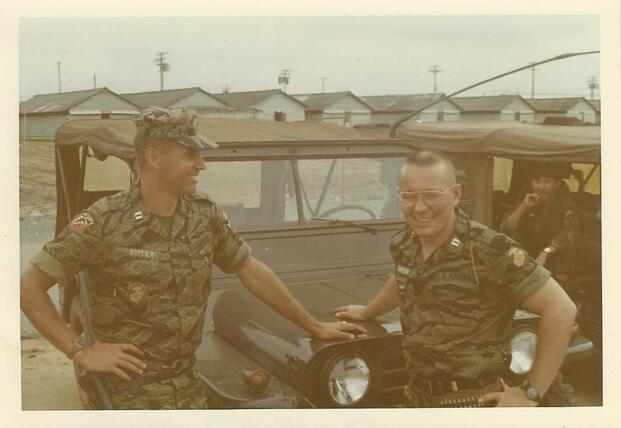
Ripley, then a Marine Captain, was assigned as an advisor to the 3rd Battalion of the South Vietnamese Marine Corps in South Vietnam.
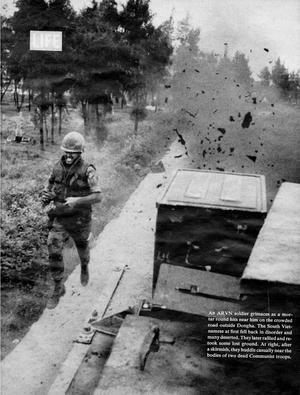
Across the Demilitarized Zone, North Vietnamese forces launched a massive conventional invasion involving tens of thousands of troops supported by tanks and artillery.
For the soldiers near Dong Ha, the situation quickly became dire.
“There were 300 men in the battalion with one U.S. Marine advisor,” Tom Ripley said. “Across the river were tens of thousands of North Vietnamese soldiers and over a hundred tanks.”
The only obstacle between those armored columns and the road south was a single bridge.
The Bridge That Could Decide the Battle
The Dong Ha Bridge spanned the Cua Viet River near the city of Dong Ha. It was the only crossing in the region capable of supporting heavy armored vehicles.
If North Vietnamese tanks crossed the bridge intact, they could surge south into the northern provinces of South Vietnam.
Ripley and other advisors quickly grasped what they were facing.
On the far side of the river were elements of the North Vietnamese 308th and 304th Divisions, supported by tanks from the 203rd Tank Regiment.
“We’ve got to blow that bridge at Dong Ha,” Ripley reportedly told fellow advisors. “We’ve got to buy some time.”
The bridge had to be destroyed. But there was no prepared demolition plan. Someone would have to climb beneath the bridge and place the explosives by hand.
Hanging Beneath the Bridge
Ripley was the only officer present with the demolitions expertise required for the mission.
A graduate of Army Ranger School, and the Royal Marines Commando Course, he had the specialized training needed to improvise the demolition. But executing the mission would require extraordinary endurance.
The bridge was under enemy fire, and the explosives available had to be carried manually. Ripley began hauling ammunition crates packed with explosives under the bridge.
Then he climbed beneath the steel girders supporting the roadway. Suspended above the river, he began attaching demolition charges.
Ripley made five separate trips, dragging explosives (500 pounds in total) across the beams and positioning satchel charges and blocks of Composition B.
Enemy rounds struck the structure around him. Exhausted and injured, Ripley later recalled repeating a simple prayer to keep moving.
“Jesus, Mary, get me there.”
On the bridge above, South Vietnamese Marines held their positions, firing anti-tank rockets and machine guns to prevent North Vietnamese armor from crossing.
“My father would be the first to say it wasn’t just him,” Tom Ripley said. “It was the entire battalion holding those tanks back while he worked.”
Eventually, Ripley detonated the charges. The bridge collapsed into the river.
Buying Time for the Joint Force
The destruction of the bridge halted the armored advance. North Vietnamese forces were forced to stop north of the river, creating a bottleneck that allowed other advisors the ability to escape and allowed U.S. airpower and naval gunfire to attack the concentrated enemy units.
Among the ships providing support was the destroyer USS Buchanan (DDG-14), which moved close to shore to deliver continuous naval gunfire.
Ripley later reflected on the moment with blunt honesty.
“The idea that I would even finish the job before the enemy got me was ludicrous,” he once said.
“When you know you’re not going to make it, a wonderful thing happens: you stop being cluttered by the feeling that you’re going to survive.”
The destruction of the bridge slowed the invasion long enough for South Vietnamese forces to regroup and mount a defense.
A Family Defined by Service
For Tom Ripley, the story of Dong Ha Bridge was never just a historical event. It was part of the fabric of his life.
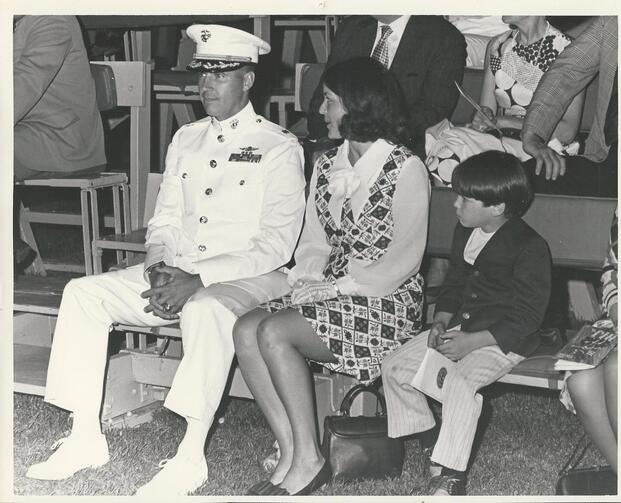
The Ripley family has a deep tradition of service in the Marine Corps.
“My father and his brothers were Marines,” Tom Ripley said. “One of them was killed in action. My brother and I are Marines. My nephews are Marines. My son is finishing his senior year at the Naval Academy.”
In the Ripley household, military service was less a topic of conversation than a shared way of life.
“It’s not something we talk about,” he said. “It’s something we live.”
Growing up, Tom Ripley said his father rarely focused on his own actions during the battle.
Instead, he emphasized the Marines and sailors who fought alongside him.
“He always said nothing great is accomplished by the individual,” Tom Ripley said. “It’s always accomplished by the team.”
The Marines Who Were There
For the surviving veterans who fought during those desperate days in 1972, the Medal of Honor represents something larger than the recognition of a single Marine.
Many of the officers involved in the battle remained close throughout their lives. Some are now in their 80s and 90s. Tom Ripley recently called several of them to share the news that the award was moving forward.
Their reactions were immediate and emotional. “It’s about damn time,” several of them told him.
One Marine general who fought in the battle told Tom Ripley that the destruction of the bridge likely saved his life.
“I’m here today because your dad blew that bridge,” he said.
For many of those veterans, the recognition represents something deeply personal.
“This closes the circle,” Tom Ripley said. “One of theirs is being recognized for something they all went through.”
A Long Road to Recognition
Ripley initially received the Navy Cross for his actions at Dong Ha Bridge. But many Marines believed the award never fully reflected the magnitude of the battle.
Over the years, multiple efforts were made to upgrade the award.
Ripley died in 2008 before the recognition could be reconsidered. Still, his son never stopped believing it would happen.
“I always believed our country would eventually see this the right way,” he said.
A Legacy for Future Marines
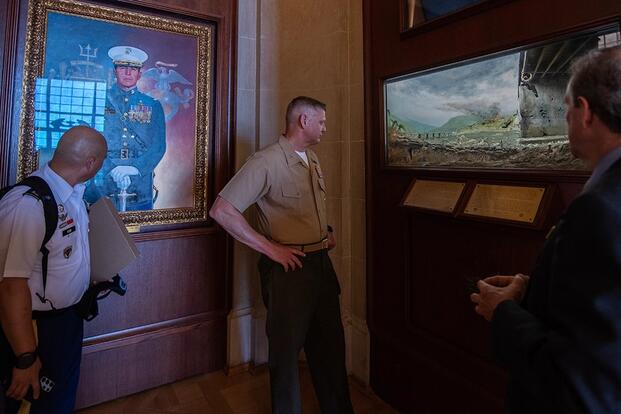
Within the United States Marine Corps, Ripley’s story has become a leadership lesson for generations of young Marines.
Ripley often summed up leadership in simple terms. “Leadership is a contact sport.”
To him, leadership meant being physically present where decisions mattered most.
“You have to be where the metal meets the meat,” Tom Ripley recalled his father saying.
It was a philosophy Ripley lived by throughout his career.
For Marines studying the battle today, the story represents something deeper than heroism. It represents the responsibility leaders carry when the mission depends on them.
Bringing the Veterans Together
Tom Ripley hopes the award ceremony will bring together the surviving Marines who fought in that battle.
Many of them have spent decades carrying the memory of those days.
“There are still people alive who saw this in color,” he said. “They need to be in the room.”
For the Marine Corps and the broader military community, the recognition represents long-awaited acknowledgment of one of the most extraordinary acts of battlefield leadership in modern American history.
And for a son who has spent decades preserving his father’s legacy, the moment carries a deeply personal meaning.
“I miss my dad,” Tom Ripley said. “But to see him recognized alongside those who wear that medal — it’s incredibly special.”
More than five decades after a Marine crawled beneath a bridge to stop an army, the nation is finally recognizing the moment that Marines have remembered for generations.





