


President Donald Trump used one of the most-watched political stages in America Tuesday night to spotlight something far removed from tax policy and border debates: battlefield valor.
During his 2026 State of the Union address, Trump awarded, or announced the awarding of, two Congressional Medals of Honor, recognizing acts of heroism separated by more than seven decades but united by what the president called “extraordinary American courage.”
The moments briefly transformed the House chamber from a partisan arena into a military ceremony complete with uniformed officers, wounded warriors, and a 100-year-old Navy fighter pilot receiving the nation’s highest military decoration.

A Modern Mission Under Fire
The first Medal of Honor went to Army Chief Warrant Officer 5 Eric Slover, a helicopter pilot wounded during a January raid that Trump said resulted in the capture of Venezuelan leader Nicolás Maduro.
In describing the mission, Trump painted a vivid picture of a Chinook helicopter descending under heavy fire.
“While preparing to land, enemy machine guns fired from every angle, and Eric was hit very badly in the leg and hip, one bullet after another,” Trump said. “And yet… Eric maneuvered his helicopter with all of those lives and souls to face the enemy.”
According to the president’s account, Slover absorbed multiple gunshot wounds but continued flying long enough to reposition the aircraft so door gunners could suppress enemy fire, preventing what Trump described as a potential “catastrophic crash deep in enemy territory.”
Only after safely landing the aircraft did Slover turn control over to his co-pilot, telling him, “I’m about ready to pass out.”
“In recognition of Eric’s actions above and beyond the call of duty,” Trump said, “I would now like to ask General Jonathan Braga to present Chief Warrant Officer Slover with our nation’s highest military award, the Congressional Medal of Honor.”
The chamber rose in applause as Slover, still recovering from his wounds, stood alongside his wife.
For today’s force, the moment carried weight beyond ceremony. It highlighted the continued risks facing special operations and aviation crews in high-threat environments, even in missions outside traditionally recognized war zones.
Trump added that 10 other service members involved in the raid would receive medals at a later White House ceremony.
A Dogfight Finally Recognized
The second Medal of Honor recognized a very different chapter of American military history.
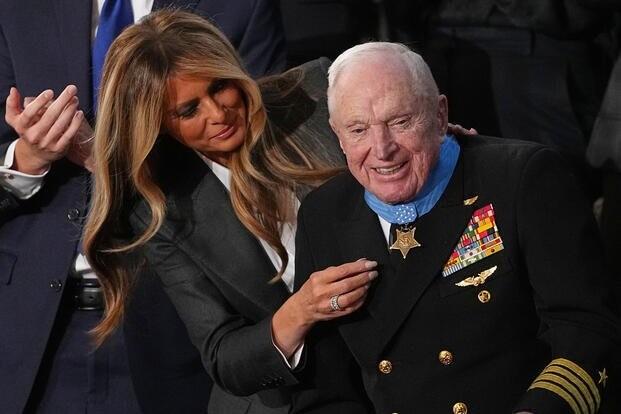
Retired Navy Capt. E. Royce Williams, 100 years old, was honored for aerial combat during the Korean War, a dogfight that remained classified for decades due to Cold War sensitivities.
In 1952, flying a Grumman F9F Panther, Williams engaged seven Soviet MiG-15 fighter jets in blizzard conditions over the Sea of Japan. Outnumbered and outgunned, he shot down four enemy aircraft while sustaining more than 200 bullet strikes to his own jet.
His story remained largely unknown for more than half a century.
“Tonight, at 100 years old, this brave Navy captain is finally getting the recognition he deserves,” Trump said.
Williams had previously received the Silver Star and later the Navy Cross. Congressional action ultimately waived statutory time limits to allow the Medal of Honor upgrade.
As First Lady, Melania Trump placed the medal around his neck, the chamber delivered one of the evening’s longest standing ovations.
For veterans and historians, the moment underscored an ongoing effort within the Defense Department to revisit past awards and ensure acts of valor are properly recognized, even decades later.
A Rare State of the Union Moment
While presidents frequently highlight service members during State of the Union addresses, actually presenting the Medal of Honor in the chamber is rare.
The contrast was striking: one recipient represented today’s operational force, helicopter crews flying into hostile airspace, while the other symbolized the enduring legacy of Cold War aviators whose stories were once shrouded in secrecy.
Together, they formed a narrative arc that spanned from the Korean Peninsula to modern-day Latin America.
Trump framed the awards within a broader patriotic theme as the country approaches its 250th anniversary in 2026.
“Everything our nation has done, everything we have achieved has been the work of those few great lifetimes,” he said.
What It Means for the Military Community
Beyond the politics of the speech, the awards served as a reminder of the standards embedded in the Medal of Honor citation itself: “conspicuous gallantry and intrepidity at the risk of life above and beyond the call of duty.”
For active-duty service members, Slover’s recognition reinforced that valor in contemporary missions, even outside formally declared wars, carries the same weight as historic battlefield heroics.
For veterans, Williams’ award signaled that unfinished recognition can still be addressed, even generations later.
In a speech dominated by sweeping claims about defense spending, recruitment and foreign policy, the two Medal of Honor presentations cut through with something simpler and harder to politicize: sacrifice.
As Trump put it while standing beside the recipients, “That’s our highest honor… and it’s an honor to be in the same room with you.”
For a few minutes, the focus was not on budgets or geopolitics, but on the individuals who carried out missions when the cost was measured not in dollars, but in blood.





