


A Buffalo Soldier from New Haven, Connecticut, who disappeared during the Allied push through northern Italy in 1944 has been identified and buried with full military honors at Arlington National Cemetery, the Defense POW/MIA Accounting Agency announced.
U.S. Army Pfc. St. Clair M. Gibson, 30, was accounted for May 7, 2025. The agency issued an initial announcement days later but held the full case details until his family received their complete briefing.
DPAA released the remaining information on March 10, 2026, the day Gibson was laid to rest at Arlington.
"After taking care of this unknown Soldier for all of these years, it was a profound honor to be able to place a rosette by his name knowing he has been identified and returned home to his family," Eryth Zecher, Florence American Cemetery superintendent, said in remarks provided to U.S. Army Garrison Italy.
A Segregated Division Enters the Gothic Line
Gibson was born on March 14, 1914 in New Orleans, but was raised in New Haven by his aunt and uncle, Bessie and Alfred Gibson. He enlisted in the U.S. Army in 1941 and over the course of his service, earned nine medals, including the Silver Star.
Gibson was assigned in September 1943 to Company F, 2nd Battalion, 371st Infantry Regiment, 92nd Infantry Division. Because the U.S. Army maintained racial segregation during the war, the 92nd's enlisted ranks were composed entirely of African American soldiers, led by mostly white officers.
The division carried the "Buffalo Soldier" nickname from the 19th-century Black cavalry tradition. Activated Oct. 15, 1942, at Fort McClellan, Alabama, the 92nd was the only African American unit to fight as a full division in World War II, according to the U.S. Army Military History Institute.

After training at Fort Huachuca, Arizona, the division deployed to Italy in the fall of 1944 and joined the U.S. Fifth Army as it pushed up the peninsula from Rome toward the Alps. The 92nd drew a sector on the western, Ligurian-coast flank of the advance.
The Gothic Line was Germany's last major defensive position in Italy, running through the northern Apennines. Between September 1944 and April 1945, elements of the 92nd fought heavy combat against Axis forces along it.
Missing on Monte Canala
In November 1944, the 371st Infantry Regiment hit the German positions near Seravezza and pushed to advance up Monte Canala against heavy resistance. Gibson went missing on Nov. 18 while leading a grenade charge. The terrain was so steep and contested that his unit could not reach him before the battle lines shifted. Because of that, his remains were not recovered.
After the war, the American Graves Registration Service, part of the U.S. Army Quartermaster Corps, sent search teams across Italy's battlefields. One set of remains recovered from Monte Canala was designated X-272 Castelfiorentino. Investigators could not match X-272 to any missing soldier because of technological limitations.
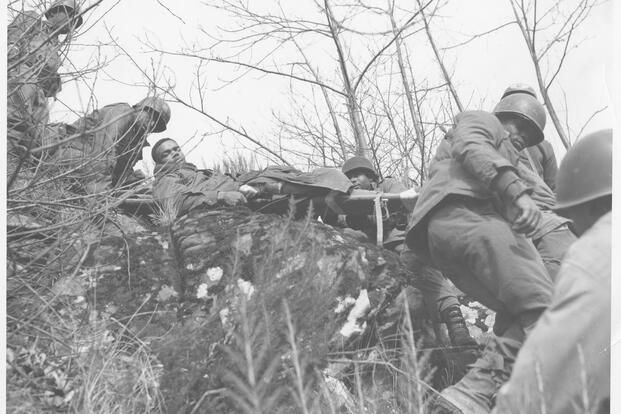
The remains were buried as an Unknown at Florence American Cemetery in Impruneta, Italy. On July 8, 1949, the Quartermaster Corps declared Gibson nonrecoverable, and all active searching for him was stopped.
When the war ended, 53 men from the 92nd were still unaccounted for. DPAA launched the 92nd Infantry Division Project in 2014 to work through the unknowns buried in Italian soil.
Home After 81 Years
In July 2017, the Defense Department and the American Battle Monuments Commission disinterred X-272 from Florence American Cemetery and sent the remains to the DPAA laboratory for analysis. Scientists used dental and anthropological examination to study the remains.
The Armed Forces Medical Examiner System performed mitochondrial DNA and nuclear single nucleotide polymorphism testing on samples from them. The combined scientific and circumstantial evidence matched X-272 to Gibson.
The identification came nearly eight years after X-272 first reached the DPAA laboratory. The agency has said its 92nd Infantry Division Project has been slowed primarily by gaps in family reference DNA, with many families hard to trace because of postwar relocation.
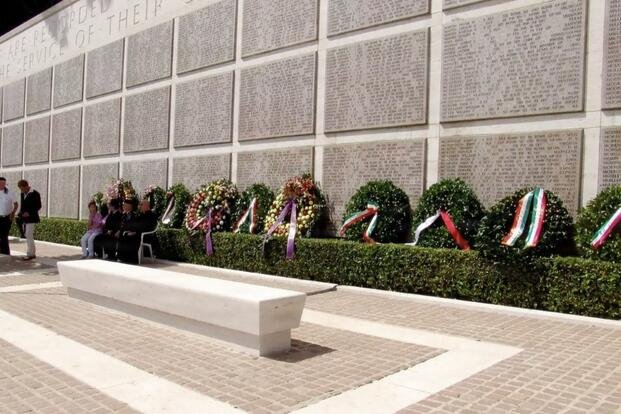
Gibson's name is inscribed on the Tablets of the Missing at Florence American Cemetery, which carry 1,409 names of service members who disappeared in the Italian campaign, according to the American Battle Monuments Commission.
A rosette will be placed beside his name to mark that he has been accounted for.
The 92nd Infantry Division was inactivated Nov. 28, 1945, and was never reconstituted. President Harry S. Truman ordered the integration of the U.S. military in 1948.
Two members of the 92nd earned the Medal of Honor for their service in Italy, 1st Lt. Vernon Baker and 1st Lt. John R. Fox. However, the service and sacrifice of men like Gibson was heavily overshadowed and forgotten due to racial discrimination.
DPAA researchers continue to work through the remaining unknowns tied to the 92nd. The agency asks relatives of missing Buffalo Soldiers to contact the Army Casualty Office at 800-892-2490 to provide DNA reference samples.
"As with all of the service members we watch over, this reaffirms their sacrifices will be remembered and their stories preserved for future generations," Zecher said.


")




")


