


By the spring of 1988, the United States had endured nearly a decade of humiliation in the Middle East.
In 1979, Iranian revolutionaries took 52 American hostages and held them for 444 days. The Desert One rescue mission failed the following year, leaving eight servicemembers dead in the Iranian desert. A suicide bomber killed 241 Marines and sailors in Beirut in 1983. An Iraqi jet attacked the USS Stark in 1987, killing 37 American sailors.
Iran referred to America as a "paper tiger."
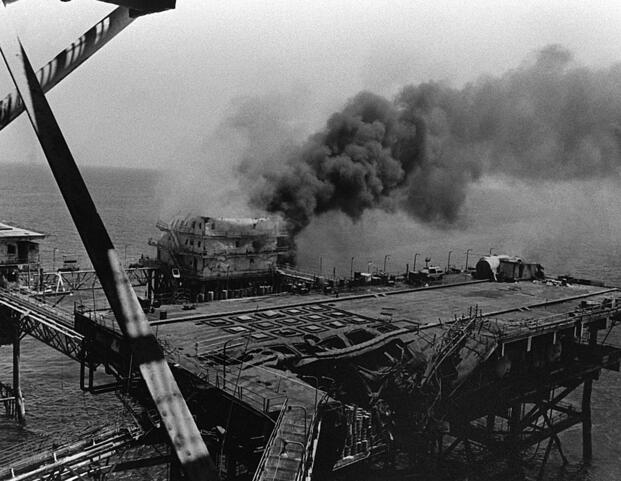
Then on April 18, 1988, the U.S. Navy destroyed two Iranian oil platforms, sunk one frigate and a missile boat, crippled a second frigate, destroyed at least three armed speedboats, and drove off Iranian F-4 Phantom jets with missile fire. In just a few hours, American forces obliterated nearly half of Iran's operational fleet.
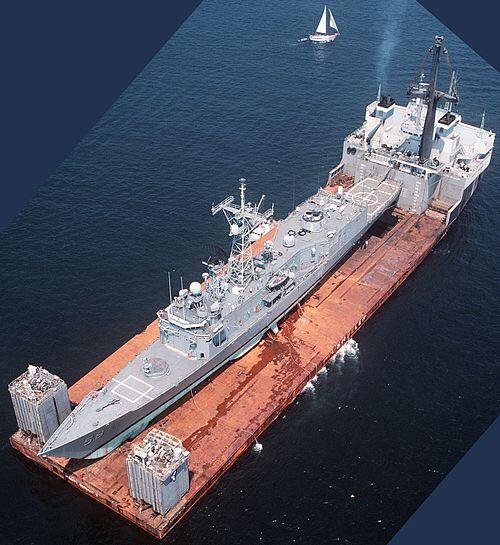
The USS Samuel B. Roberts
By 1988, Iran and Iraq had been locked in a brutal war for nearly eight years. Hundreds of thousands had died in grinding trench warfare reminiscent of World War I. Both nations sought to strangle the other's economy by attacking oil tankers in the Persian Gulf.
Iran's Revolutionary Guard Corps laid mines in international shipping lanes and used small speedboats to harass and attack merchant vessels. The conflict became known as the Tanker War.
The guided-missile frigate USS Samuel B. Roberts sailed through these dangerous waters as part of Operation Earnest Will. The mission was to escort reflagged Kuwaiti oil tankers through the Gulf and protect them from Iraqi and Iranian attacks.
At 4:45 p.m. on April 14, lookouts spotted mines floating in the water. Cmdr. Paul Rinn, the ship's captain, ordered the crew to battle stations and began backing the ship out of the minefield.
"I think we're in a minefield," Rinn announced to his crew. "I want you all to go to your general quarters stations but get up above the main deck. I'm confident we can get out."

Twenty-five minutes later, a SADAF-02 mine detonated directly beneath the ship. The explosion ripped a 15-foot hole in the hull, broke the keel, flooded the engine room and knocked both gas turbine engines off their mounts. The blast threw Rinn from the bridge wing and broke his left foot.
Ten sailors suffered injuries. Four were seriously burned. The ship should have sunk with such damage to the hull. Rinn's relentless crew training prior to the mission managed to save it.
"We practiced, drilled, and practiced and drilled some more," Rinn later recalled. "Until the crew was convinced that we could do everything faster and better than anyone."
The crew fought fires and flooding for seven hours. A boatswain's mate, sonar technician, shipfitter, cook and radioman rigged emergency power in 22 minutes. When Rear Adm. Anthony Less radioed to ask about potentially abandoning ship, Rinn refused.
"No higher honor," he replied. It was the ship's motto, a nod to the first Samuel B. Roberts, sunk at Leyte Gulf in 1944 after charging a fleet of Japanese battleships. The ship was then hauled out of the area for repairs.
Navy divers recovered additional mines from the water. Serial numbers matched mines seized from an Iranian minelayer the previous September. There was no question who was responsible.
The American Response
The Chairman of the Joint Chiefs of Staff, Adm. William Crowe, personally called Rear Adm. Less with specific instructions. Destroy two Iranian oil platforms being used as command-and-control centers for attacks on shipping. Sink the Iranian frigate Sabalan, notorious for deliberately targeting the bridges and crew quarters of unarmed merchant ships.
Less assembled three Surface Action Groups. The aircraft carrier USS Enterprise waited in the Gulf of Oman with a full air wing. Operation Praying Mantis would begin at 8 a.m. on April 18.
At dawn, SAG Bravo approached the Sassan oil platform. Capt. James Perkins aboard the USS Merrill broadcast warnings in English, Arabic, and Farsi. The Iranian workers had 20 minutes to evacuate.
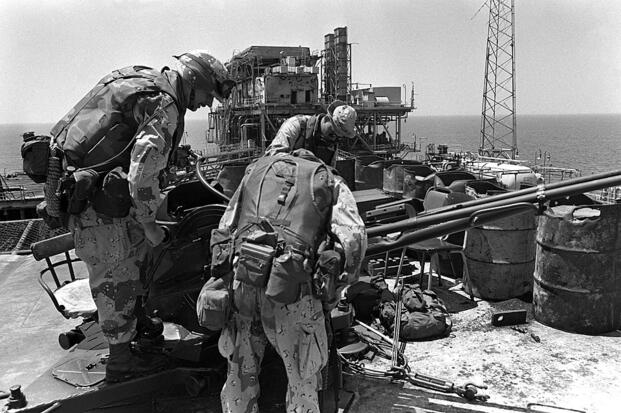
Some Iranians fled to a few tugboats. Others stayed and opened fire with twin-barreled 23mm anti-aircraft guns. American destroyers answered with 5-inch naval guns. Marine AH-1 Cobra helicopters then silenced the remaining resistance with TOW missiles.
Marines fast-roped onto the platform, gathered intelligence and planted 1,200 pounds of C4 explosives. The detonation turned the Iranian outpost into a fireball that was visible for miles.
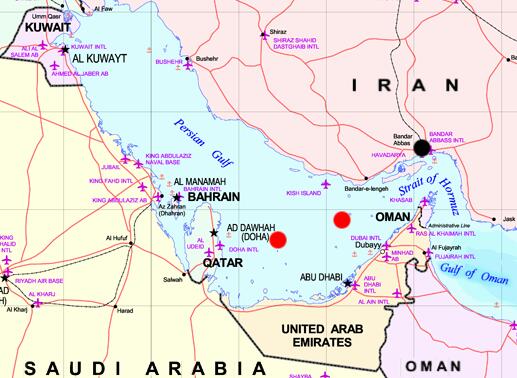
SAG Charlie hit and destroyed the Sirri platform simultaneously. Iran responded by sending Revolutionary Guard Boghammar speedboats to attack targets across the Gulf.
Armed with machine guns and rocket-propelled grenades, the small fast boats struck civilian vessels in the Mubarak oil field near the United Arab Emirates. They hit an American-flagged supply ship, a Panamanian oil rig and a British tanker before racing back toward Iranian-controlled waters.
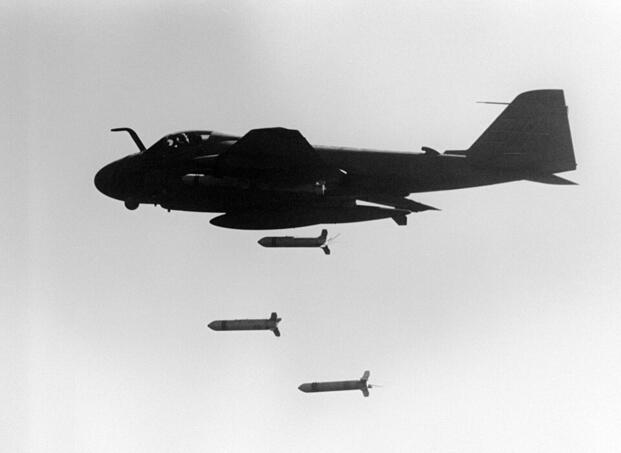
A-6E Intruders from the Enterprise intercepted them. The attack aircraft dove on the speedboats and released Rockeye cluster bombs. At least one Boghammar was destroyed with all hands. Four others fled to Abu Musa Island and beached themselves to escape destruction.
The Iranian Navy's main response came shortly after noon.
Surface Actions
The missile boat Joshan sortied from Bushire and raced toward the American ships. Aboard the guided-missile cruiser USS Wainwright, Capt. James Chandler watched his radar screen as the Iranian vessel closed on his task force.
Chandler knew his adversary well. Intelligence had provided photos of the Joshan's commanding officer, Lt. Cmdr. Abbas Mallek. More importantly, Chandler knew the Joshan carried a Harpoon anti-ship missile. It was the only functioning Harpoon in Iran's entire arsenal.
Chandler issued his first warning at noon.
The Joshan's captain replied, "I am doing my duty. I am in international waters and will commit no provocative attack."
The Iranian boat kept coming. Chandler issued four more warnings. The Iranian captain ignored them all.
Aboard the USS Simpson, Capt. James McTigue waited at his battle station. He had joined the ship just four months earlier.
"I was the rookie, I was the new guy on board," McTigue recalled.
But he had combat experience from Vietnam. His weapons officer, Lt. Mark Tierney, had his fire-control radar locked on the Joshan.
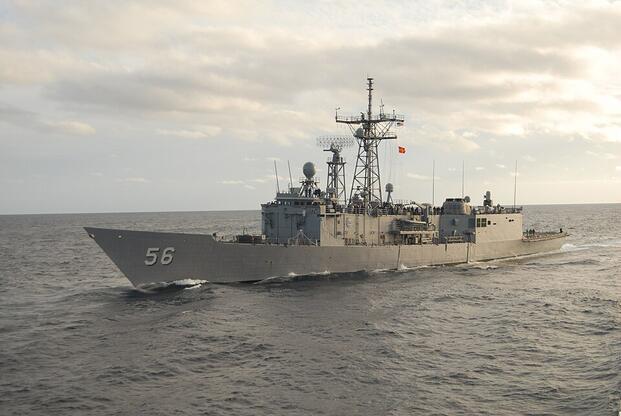
"We were locked and loaded and ready to go," said Tom Buterbaugh, who manned the Simpson's combat systems. "We already had a war shot, a white bird on the rail, all of our fire control radars were pointing right at him."
At 12:15, with the Joshan just 13 nautical miles away, Chandler keyed his radio one final time. "Stop and abandon ship. I intend to sink you."
The Joshan's response was to lock its fire-control radar onto the Wainwright and launch its Harpoon.
What followed became the only ship-versus-ship missile duel in U.S. Navy history. The Wainwright's crew fired chaff canisters and activated electronic countermeasures. The Iranian missile roared past the starboard side, missing by roughly 100 feet.
Chandler radioed the Simpson and transmitted the permission to fire.
McTigue turned to Tierney and gave him the order to shoot.
The entire sequence took less than three seconds. A Standard missile screamed off the Simpson's rail at 1,900 mph. Fifteen seconds later, it slammed into the Joshan.
Four more American missiles followed. The Joshan became a burning hulk. The three American ships closed in and finished it with 5-inch and 76mm gunfire. The Iranian boat sank at 4:21 p.m. The Simpson had become the last modern U.S. Navy warship to sink an enemy vessel in combat.
Iranian F-4 Phantoms scrambled from Bandar Abbas to challenge the American ships. The Wainwright's radar tracked three fighters approaching SAG Charlie. Chandler ordered the launch of two RIM-67 Standard missiles. At least one found its mark. Shrapnel tore into the lead Phantom.
The damaged aircraft limped back to base trailing smoke. The remaining Iranian jets broke off their attack.
The Charge of the Iranian Frigates
The Iranian Navy had larger ships. Two Saam-class frigates, the Sahand and Sabalan, were modern British-built warships capable of challenging American forces. They had been hiding at Bandar Abbas, moored between civilian tankers for protection.
That afternoon, the Sahand steamed out to fight.
Cdr. Arthur "Bud" Langston spotted it from 15,000 feet. The Navy A-6 Intruder pilot dove toward the Iranian frigate to confirm its identity. He flew low and fast, passing so close he could see sailors on the ship's deck. The Sahand's gunners opened fire with anti-aircraft weapons and launched surface-to-air missiles.
Langston climbed, keyed his radio, and broadcast a warning to give its crew time to evacuate.
"I'm going to sink you in five minutes," he said.
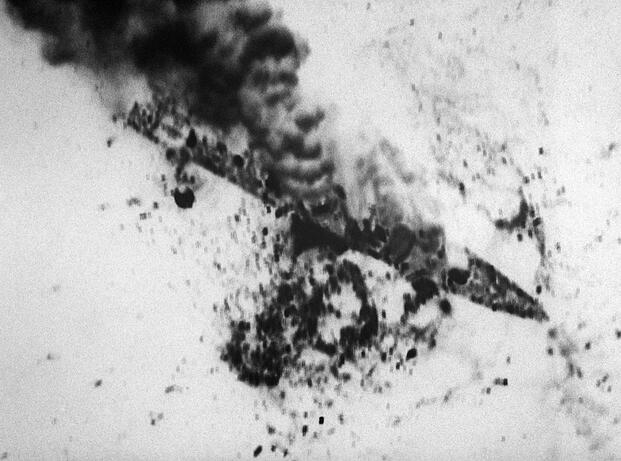
The Iranian ship kept moving forward. Langston moved to attack.
"I shot the Harpoon, which exploded right behind the ship's bridge," Langston later recalled. "The frigate billowed smoke and went dead in the water quickly. Then I made attacks with two Skippers and followed up with the laser-guided bombs."
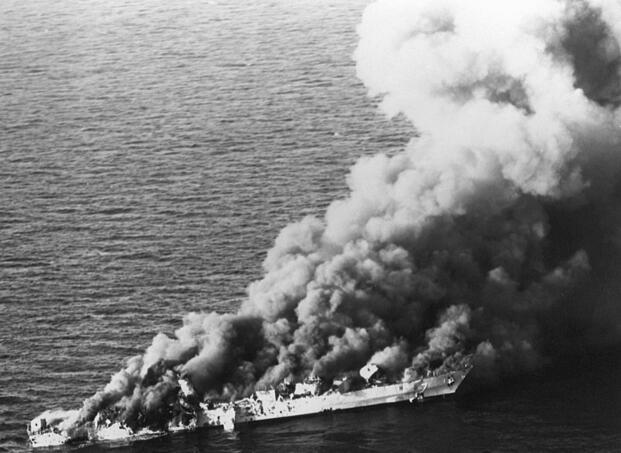
The destroyer USS Joseph Strauss added a Harpoon of its own. More A-6s and A-7 Corsairs piled on with cluster bombs. The Sahand burned for hours. When fire reached its magazines, the ship exploded and sank, taking 45 crewmen with it.
Near dusk, the Sabalan finally emerged from hiding. Lt. Cmdr. James Engler found it and made his attack run in his A-6 Intruder. The frigate fired a surface-to-air missile that missed. Engler dove at a 45-degree angle through heavy anti-aircraft fire and released a 500-pound laser-guided bomb.
It went straight down the Sabalan's smokestack.
The explosion in the engine room left the frigate dead in the water, stern partially submerged. Engler circled for another run. More aircraft arrived on station, ready to assist.
Then came the order to stand down. Defense Secretary Frank Carlucci and Admiral Crowe decided enough damage had been done. President Reagan himself intervened, telling Crowe the Iranians "had enough for one day." An Iranian tug eventually towed the Sabalan back to port.
The Cost of Victory
The only American losses occurred when a Marine AH-1T Sea Cobra helicopter from HML/A-167 crashed into the Gulf about 15 miles southwest of Abu Musa Island. Marine Captains Kenneth Hill, 33, and Stephen Leslie, 30, both died.
Their last transmission indicated they were evading hostile fire. The wreckage showed no battle damage. Investigators concluded the pilots may have crashed while maneuvering to avoid Iranian missiles.
Iran lost the frigate Sahand, the missile boat Joshan, and at least three Boghammar speedboats sunk. The frigate Sabalan was crippled. At least one F-4 Phantom was damaged by American missiles and limped back to base. Two oil platforms were destroyed.
"This particular exercise, in my view, finished the Iranian Navy in the Arabian Gulf," said Capt. Perkins. "They were still around, but after that operation, they didn't have as active a stance."
In fact, Iran had just lost roughly half of its operational navy in only a few hours.
A Day of Redemption
Operation Praying Mantis stands as the largest U.S. Navy surface engagement since World War II. It was the first and only time American warships exchanged anti-ship missiles with an enemy. The sinking of the Sahand marked the largest warship sunk by the U.S. Navy since 1945.
Naval historian Craig Symonds later ranked it among "one of the five most significant sea battles in United States history."
"I felt proud then and I still feel proud today," said Tierney, who received the Bronze Star for his actions that day.
Rear Adm. Langston, reflecting years later, saw the operation as a turning point for America's standing in the region.
"Operation Praying Mantis gave the U.S. Navy the opportunity for America to regain credibility," he wrote. "And credibility is directly linked to restoring our national pride."
Unfortunately, tensions did not settle after Praying Mantis ended. On July 3, 1988, the guided-missile cruiser USS Vincennes, operating in the same waters, mistakenly shot down Iran Air Flight 655. All 290 passengers and crew aboard the civilian airliner died. The U.S. government maintained the crew had confused the Airbus with an attacking Iranian F-14 fighter.
A declassified CIA report later revealed that Iran believed the American attack during Praying Mantis was coordinated with an Iraqi offensive that happened to launch the same morning.
Convinced they faced a two-front war and with both sides suffering egregious losses for little gain, Iranian leaders agreed to a United Nations ceasefire resolution that summer. On August 20, 1988, the eight-year Iran-Iraq War finally came to an end. Nearly 2 million soldiers and civilians on both sides died during the conflict.
The United States had suffered several serious setbacks and losses in the region during the 1980s. Operation Praying Mantis showed the world, especially the Iranians, that the U.S. military would not let unprovoked attacks go unpunished.





