


Col. Clarence E. "Bud" Anderson, the last surviving American triple ace of World War II, was laid to rest Monday at Arlington National Cemetery with full military funeral honors with escort, nearly two years after his death at age 102.
Anderson died on May 17, 2024, at his home in Auburn, California. He was interred in Section 38 on March 30 next to his wife Eleanor "Ellie" Cosby. The two had been married for nearly seven decades before her death in January 2015.
Arlington National Cemetery
More than 100 mourners gathered for the ceremony, which included a horse-drawn caisson procession, a three-volley rifle salute, the playing of Taps and a bagpipe rendition of "Amazing Grace."
Two separate flyovers honored Anderson during the service. F-35 Lightning IIs opened the tribute, then a group of P-51 Mustangs closed it with a Missing Man Formation. Two of the Mustangs bore the name "Old Crow," the nose art Anderson had painted on every fighter he flew in combat.

Jim Anderson, the colonel's son, said that the P-51 formation was something the family had worked to arrange. The F-35 flyover, however, caught them off guard.
"That was really special," he said.
Air Force Chief of Staff Gen. Ken Wilsbach served as the general officer host. After the Color Guard folded the American flag over Anderson's urn, Wilsbach presented it to Jim, who shared it with his sister, Katherine "Kitty" Burlington.
Wilsbach and Chairman of the Joint Chiefs Gen. Dan Caine flew with the flag the week before the ceremony, Wilsbach in an F-22 Raptor and Caine in an F-16.
"'Bud' Anderson is a hero and legend in air combat; he wrote the playbook," Wilsbach said. "He mastered his craft, flew with immense courage and leaves a legacy of service that will inspire generations."
The Pilot of ‘Old Crow’
Anderson was born in Oakland on Jan. 13, 1922 and grew up on a farm outside Newcastle, California. He developed a fascination with aviation early on, and by 19 he had earned his private pilot's license through the Civilian Pilot Training Program while attending Sacramento Junior College.
In January 1942, just weeks after the attack on Pearl Harbor, Anderson enlisted in the Army Air Corps Aviation Cadet Program. He earned his pilot's wings that September and was commissioned as an officer in the U.S. Army Air Forces.
He was assigned to the 363rd Fighter Squadron of the 357th Fighter Group, stationed at RAF Leiston in England. The group became known as the "Yoxford Boys" after the nearby village and went on to become one of the most successful fighter outfits in the Eighth Air Force.
Anderson flew two combat tours between November 1943 and January 1945, completing 116 missions and shooting down 16.25 enemy aircraft to earn the rare distinction of triple ace, a title reserved for pilots with 15 or more aerial kills.
He named every Mustang he flew "Old Crow," after the Kentucky bourbon. Anderson completed both tours in those aircraft without once taking fire from an enemy plane or aborting a mission.
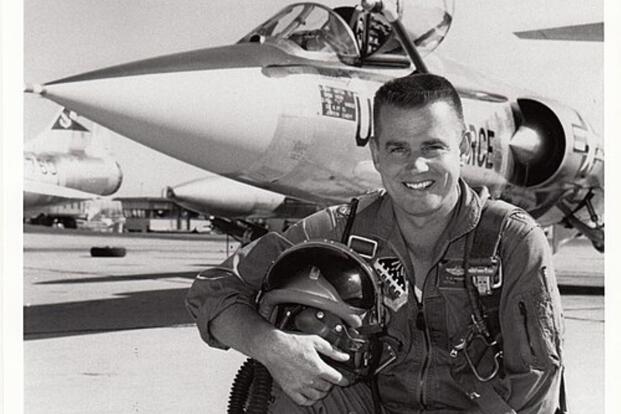
That record of survival was extraordinary even within the 357th Fighter Group, which turned out 42 aces and racked up roughly 600 aerial victories. Anderson's own 363rd Fighter Squadron paid a steep price for those numbers. Half its original pilots were killed or captured.
His close friend and fellow Yoxford Boy, Chuck Yeager, went on to break the sound barrier in 1947.
Anderson remained on active duty after the war and transitioned into the jet age as a test pilot at Wright-Patterson Air Force Base in Ohio.
After Korea, where he led an F-86 Sabre squadron, Anderson took command of an F-105 Thunderchief wing in Okinawa. He later took over the 355th Tactical Fighter Wing and flew combat missions in Vietnam.
Anderson retired in March 1972 as a colonel after 30 years of service, having served behind the controls of more than 130 different airframes while accumulating over 7,500 hours in the air. The Air Force decorated him with five Distinguished Flying Crosses, two Legions of Merit, a Bronze Star and 16 Air Medals. France honored him with both the Legion of Honor and the Croix de Guerre.
Anderson spent his post-military career running flight test operations for McDonnell Douglas at Edwards Air Force Base, a job he held until 1998. He co-wrote his memoir, "To Fly and Fight," in 1990.
The National Aviation Hall of Fame added him to its ranks in 2008. He also received an honorary promotion to brigadier general in December 2022. He continued to fly until age 90 and took his last ride in a P-51 as a passenger at age 100.
A Vanishing Generation
The 22-month gap between Anderson's death and his burial at Arlington, while striking, is not unusual. A Pentagon Inspector General report found that wait times at the cemetery can stretch from six to 49 weeks due to high demand and limited availability of military personnel for funeral honors.
The cemetery conducts between 27 and 30 services on weekdays.
Cremated remains typically face longer scheduling timelines than casket burials, according to Arlington. The family's request to inter him in Section 38 beside Eleanor may have also extended the wait.
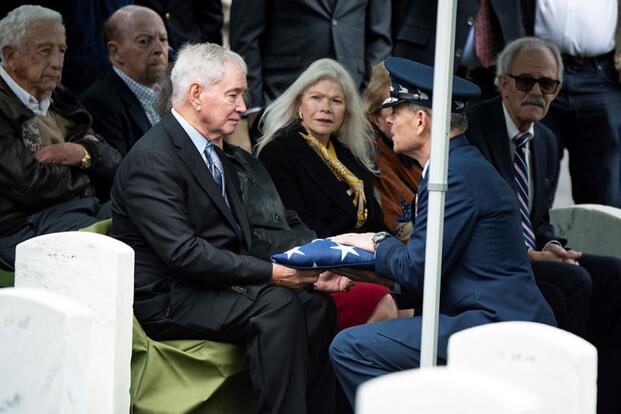
Jim Anderson, who attended the Air Force Academy and served in Vietnam before becoming a commercial airline pilot, said he had tried to keep his father's identity secret.
"When I was in the Air Force, I tried to keep it a secret who my father was because I wanted to make [my career] my own," he said. "But eventually people would find out."
Anderson's interment comes less than a year after the death of Don McPherson, a Navy pilot believed to be the country's last surviving WWII ace. McPherson died on Aug. 14, 2025, at age 103.
The American Fighter Aces Association has recognized 1,447 combat pilots as aces across all U.S. wars. Only a handful remain alive today, most of them veterans of the Korean and Vietnam wars.
With modern aerial combat shifting toward unmanned systems and beyond-visual-range missiles, the generation of fighter pilots that Anderson belonged to is quickly disappearing.





