


Two U.S. Navy fast-attack submarines dove beneath the Arctic ice cap on March 7, marking the 100th time the American submarine force has conducted under-ice operations since a World War II-era boat first navigated the polar depths nearly 80 years ago.
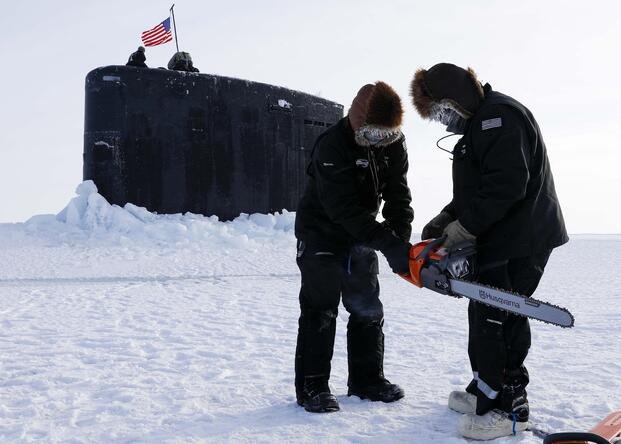
Commander, Submarine Forces, Vice Adm. Richard Seif, officially launched Operation ICE CAMP Boarfish from a drifting ice floe in the Arctic Ocean, with USS Delaware (SSN 791) and USS Santa Fe (SSN 763) serving as the operation's two participating submarines.
A Base on Moving Ice
ICE CAMP Boarfish is a three-week mission to test submarine capabilities and conduct research in Arctic conditions. The camp itself is a temporary installation built on a drifting ice floe, equipped with sleeping quarters, a command center and supporting infrastructure for a multinational team of sailors, Marines and civilians.
"The complexity of establishing a fully functional base on a moving sheet of ice cannot be overstated," said Capt. David Nichols, officer in tactical control of this year's exercise. "The professionalism and dedication of every service member and civilian here is what makes this vital mission possible."
Allied personnel joining the Americans include sailors and airmen from Australia, Canada, France, the United Kingdom and Norway, along with researchers from Japan's marine science agency and Norway's defence research institute. The U.S. Marine Corps and Air National Guard are also participating.
The Navy's Arctic Submarine Laboratory, the submarine force's designated center of excellence for polar operations, is running the mission under the broader umbrella of the Undersea Warfighting Development Center. The operation runs on a two-year cycle.
In a notable shift in how the Pentagon characterizes Arctic naval activity, the Navy elevated ICE CAMP from an exercise to a formal operation this year, a decision officials say signals the Arctic's growing place among the Navy's core strategic concerns.
From a WWII Submarine to the 100th Evolution
The camp's namesake is USS Boarfish (SS 327), a World War II submarine that earned a battle star in the Pacific for sending two Japanese ships to the bottom of the South China Sea. Three years after the war ended, Boarfish headed north for a different kind of mission.
In 1947, the Navy dispatched Boarfish as the lead vessel in Operation Blue Nose, sending her beneath the polar ice cap for the first time any submarine had attempted it. Crew members tested new sonar gear under the ice and demonstrated that a submarine could navigate Arctic waters and come home.

USS Nautilus (SSN 571) built on that foundation in 1958 with the first complete under-ice Arctic transit, and USS Skate (SSN 578) reached the geographic North Pole the following March, surfacing through the ice there for the first time.
ICE CAMP Boarfish is the 100th time the submarine force has sent boats beneath the Arctic ice since that initial voyage.
Why the Arctic Matters Now
The Navy has been explicit about why it is intensifying focus on the Arctic. Climate trends are reducing sea ice cover across the region, opening shipping lanes and making resource extraction viable at latitudes that were once inaccessible for most of the year. That commercial shift carries military implications.
"The Arctic is a critical region for national security and global stability," said Vice Adm. Seif. "Our commitment to a sustained presence and operational readiness here is unwavering. ICE CAMP Boarfish allows us to test and refine our capabilities, deepen our interoperability with key allies and ensure our submarine force can project power and defend our nation's interests in any environment, at any time."
Russia's Northern Fleet, headquartered on the Kola Peninsula, operates submarines and surface warships in the same waters, and Russian submarine activity near the GIUK Gap has been described by NATO commanders as equaling or surpassing Cold War levels. Trans-Arctic shipping routes are also becoming commercially active as ice cover recedes, adding an economic dimension to a region the Pentagon's 2024 Arctic Strategy identified as a strategic priority.
The biennial occurrence of ICE CAMP, combined with the Navy's decision this year to reclassify it as an operation rather than an exercise, reflects how much the strategic importance around the Arctic has shifted since Boarfish launched its historic mission in 1947.





